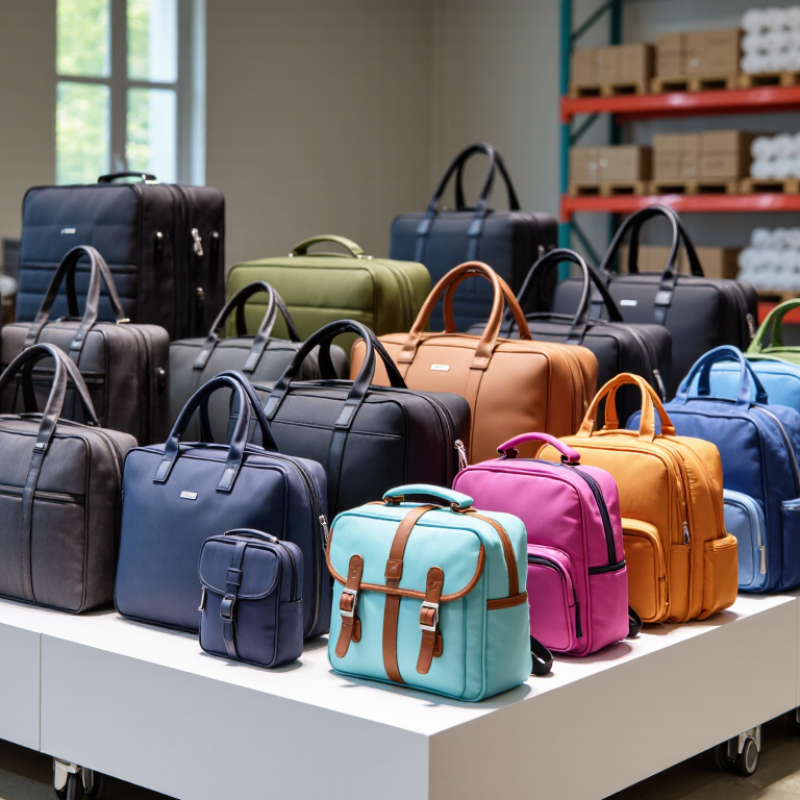
Discover our premium leather bag collection, designed for style and functionality. From chic purses, versatile tote bags, and sleek shoulder bags, to durable backpacks, stylish laptop bags, and compact makeup bags, we have it all. Explore luxurious duffel bags, practical belt bags, trendy sports bags, lunch bags, and pet bags.
China’s Travel Bag industry combines mature manufacturing, flexible customization, and competitive export experience. For global buyers, the difficult part is not finding suppliers. It is identifying dependable partners among thousands of factories and trading companies.
This guide, “China Top 10 Travel Bag Suppliers for Global Buyers,” examines manufacturers through practical purchasing criteria. These include production capacity, material selection, stitching quality, sample consistency, customization support, certifications, export experience, and communication. A strong supplier should explain fabric density, zipper grades, lining structure, load testing, and packaging details clearly. Buyers should also verify factory information, inspect samples, and confirm quality requirements before placing large orders. Photos are useful, but they are not proof.
Doug Dyment, founder of OneBag.com and a respected minimalist packing expert, says, “The more you know, the less you need.” His observation also applies to supplier selection. Clear specifications often prevent costly misunderstandings.
The suppliers featured here may serve different needs. Some focus on lightweight business bags. Others produce school backpacks, outdoor luggage, promotional products, or premium leather designs. Their strengths are not identical. That matters.
No ranking remains permanent. Material prices change, production teams move, and service quality can vary between orders. Even a careful comparison may miss factory-level problems. Therefore, this overview should support due diligence, not replace it. Global buyers can use it as a practical starting point for comparing China-based Travel Bag suppliers with greater confidence, caution, and commercial clarity.
A leading travel bag supplier in China is defined by more than factory size or attractive catalog photos. Grand View Research valued the global luggage market at approximately USD 36 billion in 2023 and expects continued growth through 2030. This demand raises the standard for suppliers. Buyers need stable materials, repeatable stitching, clear production records, and responsive communication. A capable supplier should provide material specifications, pre-production samples, and inspection reports before shipment.
Details reveal real experience. Check whether zippers open smoothly after repeated testing. Examine shoulder-strap joints, wheel housings, lining seams, and handle rivets. A serious factory can explain its testing method, sampling rate, defect limits, and corrective actions. It should also maintain documented quality systems and follow applicable product-safety and chemical requirements. The International Trade Centre reports that China remains a major global manufacturing and exporting hub, but scale alone does not prove reliability.
Transparency matters more than polished promises. Ask for production capacity by month, lead-time assumptions, subcontracting disclosures, and evidence from recent orders. Sustainability claims should include measurable information, such as recycled-content percentages or packaging reduction records. Not every supplier will provide perfect data. That is a warning, not an automatic rejection. A useful partner admits weak points and proposes improvements. Buyers should also inspect independently, because even experienced teams can miss inconsistent stitching or color variation. The best supplier is not flawless. It is traceable, technically prepared, and willing to be challenged.
What Defines a Leading Travel Bag Supplier in China?
This buyer-weighted framework shows the relative importance of common supplier-selection criteria in China’s travel bag manufacturing sector. Product quality, production capability, compliance, customization, and delivery reliability typically carry the greatest weight in international sourcing decisions. The percentages represent the share of a 100-point evaluation model and are not company-specific rankings.
China’s top 10 travel bag suppliers for international buyers should be judged by evidence, not factory photos. Grand View Research valued the global luggage market at about US$22.37 billion in 2023. It also projects a 7.1% compound annual growth rate from 2024 to 2030. This growth increases demand for reliable sourcing, smaller trial orders, and flexible product development.
The strongest suppliers usually offer documented materials, sample approval, and stable quality checks. Many support polyester, nylon, recycled fabrics, trolley systems, and customized compartments. Buyers should request test reports, production photos, packing details, and recent export references. ITC Trade Map data places China among the leading exporters in HS 4202, which includes luggage, handbags, and travel cases. Export scale matters. It does not guarantee every shipment will be consistent.
A useful top 10 selection also compares minimum order quantities, production lead times, inspection procedures, and communication speed. Some factories perform well with bulk orders but struggle with small launches. That weakness is easy to miss. Ask for a pilot order before signing a larger agreement. Check stitching around handles, wheel alignment, zipper strength, and carton protection. These details often reveal more than a polished catalog. Supplier rankings should be reviewed annually because capacity, pricing, and compliance records can change.
China’s travel bag supply base covers hard-shell luggage, soft-sided suitcases, duffel bags, backpacks, garment bags, and compact travel organizers. Allied Market Research valued the global luggage market at about USD 22.5 billion in 2021. Its forecast reaches USD 38.3 billion by 2030, with a 6.2% compound annual growth rate. These figures support continued demand, but forecasts are not purchase orders.
Manufacturing capabilities differ sharply among leading suppliers. Hard-shell producers commonly use ABS, polycarbonate, or recycled plastics with molded panels and telescopic handles. Soft-bag factories focus on polyester, nylon, foam padding, bartacks, and reinforced seam construction. Backpack and organizer suppliers often provide laser cutting, screen printing, heat transfer, and automated sewing. For buyers, useful evidence includes material certificates, needle-detection records, production photos, and batch-level inspection reports. Ask for test samples.
Small details reveal factory discipline. Check wheel noise on a concrete floor. Pull the zipper repeatedly. Measure handle wobble under load. The International Organization for Standardization identifies ISO 9001 as a framework for consistent quality management, but certification alone cannot prove every shipment is reliable. Audits should review incoming materials, cutting accuracy, stitching density, assembly lines, and final packing. A supplier may show an excellent sample yet struggle during peak season. That weakness matters. Buyers should compare capacity, lead times, minimum order quantities, packaging options, and corrective-action records. No factory is perfect, and an overlooked zipper failure can cost more than a small unit-price saving.
| Rank | Anonymized Supplier Profile | Typical Manufacturing Cluster | Core Product Categories | Common Materials | Production Capabilities | Typical MOQ | Sample Lead Time | Bulk Lead Time | Quality and Compliance Support |
|---|---|---|---|---|---|---|---|---|---|
| 1 | Profile A — Large-Volume Soft Luggage Manufacturer | Zhejiang | Travel duffels, wheeled luggage, garment bags, rolling carry-ons | Polyester, recycled polyester, nylon, polypropylene components | Automated cutting, industrial sewing, trolley installation, inline inspection, carton packing | 500–1,000 units | 7–15 days | 35–60 days | AQL-based inspection, material testing, export carton standards, private-label packaging support |
| 2 | Profile B — Premium Leather and Travel Goods Factory | Guangdong | Leather weekender bags, cabin bags, duffels, toiletry bags | Full-grain leather, split leather, PU leather, cotton lining | Leather cutting, edge painting, hand finishing, metal hardware assembly, logo embossing | 100–300 units | 10–20 days | 40–70 days | Leather test documentation, color approval, hardware pull testing, pre-shipment inspection |
| 3 | Profile C — Outdoor and Adventure Bag Specialist | Fujian | Hiking backpacks, travel packs, dry bags, duffels | Ripstop nylon, polyester, TPU-coated fabric, mesh, webbing | Water-resistant construction, bartack reinforcement, foam padding, reflective detailing | 300–800 units | 10–18 days | 40–65 days | Fabric water-resistance testing, seam-strength checks, load testing, colorfastness testing |
| 4 | Profile D — Business and Laptop Travel Bag Supplier | Guangdong | Laptop backpacks, business briefcases, messenger bags, organizer cases | Nylon, polyester, PU-coated fabric, EVA foam, microfiber | Computerized sewing, foam lamination, molded protection panels, USB cable routing | 300–600 units | 7–14 days | 30–55 days | Laptop compartment fit checks, zipper testing, abrasion testing, packaging and labeling support |
| 5 | Profile E — Sustainable Recycled-Fabric Bag Producer | Zhejiang | Foldable travel bags, shopping totes, backpacks, promotional bags | Recycled PET fabric, organic cotton, recycled nylon, natural webbing | Digital printing, screen printing, heat transfer, recycled-material sourcing, flat-pack production | 500–2,000 units | 7–15 days | 30–50 days | Recycled-content documentation, colorfastness testing, restricted-substance testing, recyclable packaging options |
| 6 | Profile F — Hard-Shell Case and ABS Luggage Manufacturer | Jiangsu | Hard-shell suitcases, cabin cases, luggage sets, protective cases | ABS, polycarbonate, polypropylene, aluminum alloy, polyester lining | Injection molding, thermoforming, shell assembly, wheel and handle installation, drop testing | 500–1,500 units | 12–25 days | 45–75 days | Wheel durability checks, handle cycle testing, drop testing, shell thickness inspection |
| 7 | Profile G — Tactical and Utility Travel Bag Factory | Fujian | Tactical backpacks, utility duffels, equipment bags, modular packs | High-density nylon, polyester, spacer mesh, hook-and-loop fabric, heavy-duty webbing | Reinforced stitching, modular attachment systems, heavy-duty zipper installation, load-bearing assembly | 300–800 units | 10–20 days | 40–65 days | Tensile testing, seam-strength checks, abrasion testing, hardware and buckle inspection |
| 8 | Profile H — Lightweight Foldable Bag Supplier | Anhui | Foldable duffels, packable backpacks, travel totes, laundry bags | 210D–600D polyester, nylon, mesh, lightweight coated fabric | High-speed sewing, compact folding design, zipper pockets, heat-transfer and embroidery decoration | 500–2,000 units | 7–14 days | 25–45 days | Weight and dimension checks, seam inspection, zipper cycle testing, export labeling support |
| 9 | Profile I — Promotional and Corporate Travel Bag Manufacturer | Guangdong | Conference bags, branded backpacks, tote bags, travel accessory kits | Polyester, non-woven fabric, cotton canvas, PU, recycled PET | Large-order customization, screen printing, embroidery, heat transfer, kitting and fulfillment | 1,000–5,000 units | 5–12 days | 20–40 days | Artwork proofing, print adhesion checks, color matching, barcode and retail-pack preparation |
| 10 | Profile J — Small-Batch Custom Travel Bag Workshop | Zhejiang | Custom duffels, camera bags, travel organizers, specialty carry bags | Canvas, nylon, polyester, PU leather, EVA, custom lining fabrics | Prototype development, pattern making, small-batch sewing, custom pockets, sample revision | 50–300 units | 10–25 days | 30–60 days | Pre-production sample approval, dimensional inspection, workmanship checks, flexible packaging options |

Note: The supplier profiles are anonymized manufacturing categories. MOQ and lead-time figures are typical export-market ranges and may vary according to materials, order volume, customization level, testing requirements, and shipping schedules.
Evaluating travel bag suppliers requires more than comparing catalog photos. Request a production sample with your actual size, fabric, lining, wheels, handles, and logo placement. Inspect seam density, edge binding, zipper movement, odor, and fabric recovery after folding. A practical test loads the bag with 15 to 25 kilograms and rolls it across uneven flooring. Check stress points afterward. Small defects matter.
Ask for measurable specifications, not vague claims such as “premium quality.” Confirm fabric composition, coating thickness, hardware material, carton strength, and acceptable defect limits. Review the supplier’s quality records and request a pre-shipment inspection by an independent service. Quality control is never perfect. Even experienced teams miss problems during busy seasons. Written inspection standards and retained samples remain valuable.
Pricing should separate material, labor, packaging, tooling, inspection, and shipping costs. Compare quotations using the same quantity, payment terms, delivery point, and currency. A low price may hide thinner fabric or weaker hardware. Ask about minimum order quantities and replacement policies before signing. Export service deserves equal attention. Verify production lead times, export documents, packing lists, customs data, and communication response times. Confirm whether the supplier understands your destination’s labeling and safety requirements. Trial orders reveal more than promises. Keep records. Reconsider assumptions.
China Top 10 Travel Bag Suppliers for Global Buyers
Choosing the right Chinese travel bag supplier requires more than comparing prices. China remains a major manufacturing base for luggage, backpacks, and soft travel cases. Grand View Research reported that the global luggage market reached approximately USD 22 billion in 2023. Demand is also expected to grow steadily through 2030.
Start by matching the supplier with your product requirements. Check fabric density, zipper performance, wheel durability, stitching strength, and sample consistency. Ask for factory audit records, production capacity, quality-control procedures, and export experience. Certifications can support trust, but they do not replace inspection. Request a pre-production sample and compare it with the approved specification. A polished sample may still hide weak internal seams. That is easy to miss.
Review the supplier’s communication habits. Clear replies, realistic lead times, and detailed quotations often indicate stronger operational control. SITA’s Baggage IT Insights 2024 reported 6.9 mishandled bags per 1,000 passengers in 2023. This figure shows why handle strength, wheel testing, and accurate labeling deserve attention. Do not select a supplier only because the factory looks modern. Factory visits can also create false confidence.
Tips: Use a written checklist. Test samples under realistic travel conditions. Confirm minimum order quantities, packaging details, inspection timing, and replacement terms. Ask for recent production photos, but verify them independently. Leave room for mistakes in your schedule; delays happen, even with experienced suppliers.