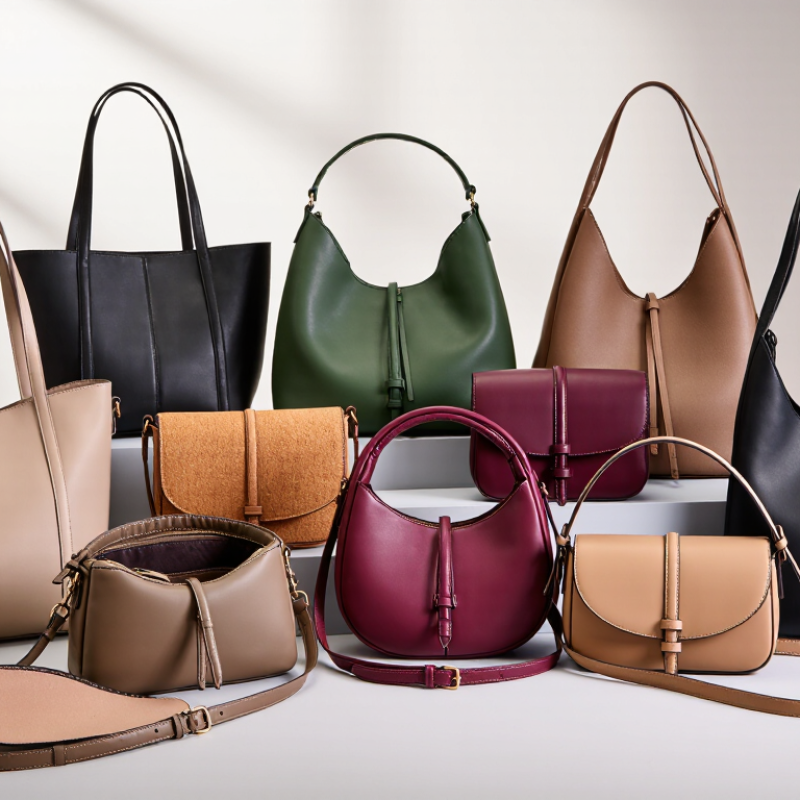
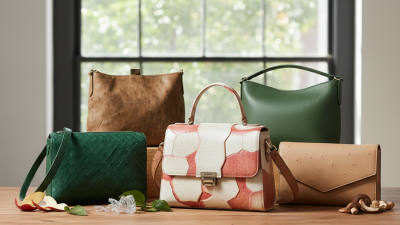
Discover our premium leather bag collection, designed for style and functionality. From chic purses, versatile tote bags, and sleek shoulder bags, to durable backpacks, stylish laptop bags, and compact makeup bags, we have it all. Explore luxurious duffel bags, practical belt bags, trendy sports bags, lunch bags, and pet bags.
Choosing a reliable Vegan Leather Handbag supplier requires more than comparing glossy catalogs. Material claims, factory experience, sampling quality, and delivery records deserve closer attention. This guide examines ten global suppliers through practical buying criteria, including material traceability, minimum order quantities, customization options, stitching consistency, and packaging standards.
Stella McCartney, a recognized sustainable fashion designer, once said, “I don’t believe you have to sacrifice style for sustainability.” That principle remains useful, but it needs careful testing. A soft cactus-based bag may feel impressive in a showroom. Its long-term abrasion performance could tell a different story. “Vegan” also describes a material category, not automatic environmental excellence.
The selected suppliers represent different strengths. Some focus on premium private-label collections. Others support large-scale production or flexible small-batch development. Their materials may include polyurethane, recycled synthetics, cork, apple fiber, cactus fiber, or other plant-based alternatives. These options are not identical. Their durability, coatings, certifications, and end-of-life challenges can vary considerably.
This list is not a perfect ranking. Supplier performance can change with new factories, material partnerships, and order volumes. Buyers should request current samples, test reports, audit information, and written production terms before committing. That step is often overlooked. It should not be.
For brands developing a Vegan Leather Handbag line, the best supplier is not always the cheapest or most famous. Consistent workmanship, honest documentation, responsive communication, and realistic production timelines usually matter more. The following comparison offers a grounded starting point for informed sourcing decisions worldwide.
Vegan leather is not one material. It describes leather-like material made without animal hides. Common handbag options include polyurethane, PVC, cork, recycled polyester, and plant-based composites. PU usually feels soft and flexible, while PVC can offer stronger water resistance. Plant-based content may come from cactus, pineapple fibers, apples, or mushrooms.
There is no single global standard that defines “vegan leather.” Responsible suppliers should provide material composition, factory details, and recent laboratory reports. Buyers can check restricted-substance testing, durability results, and recycled-content claims. Useful certifications may include Global Recycled Standard, OEKO-TEX, or credible bio-based verification. However, certification coverage differs. A certified fabric does not automatically prove ethical production throughout the supply chain.
Market estimates placed the global vegan leather sector near US$40 billion in 2023, but figures vary by research scope. Some reports include footwear and automotive materials, while others focus only on bags and accessories. This difference matters when comparing suppliers. During sourcing work, I would request abrasion testing, hydrolysis resistance, colorfastness, and coating thickness. A beautiful sample can crack after several months. That uncomfortable possibility deserves attention. “Plant-based” also sounds greener than it may be. Resin coatings, farming inputs, transport, and disposal still affect the environmental profile. Suppliers that share traceable data are generally more reliable than those offering only attractive sustainability language.
Anonymous supplier profiles for comparing commercially available vegan-leather material capabilities without displaying company or brand names.
| Profile | Common sourcing region | Vegan-leather material | Typical composition or construction | Handbag applications | Key advantages | Main limitations | Relevant standards or verification |
|---|---|---|---|---|---|---|---|
| Supplier Profile 01 | East and Southeast Asia | Polyurethane-coated textile | Textile backing with a PU surface layer; bio-based PU content varies by specification. | Body panels, handles, pockets, linings and small accessories | Soft hand feel, broad color range, scalable production and comparatively low weight | Usually contains fossil-derived polymers; end-of-life recycling can be difficult | REACHOEKO-TEX Standard 100ISO 9001 |
| Supplier Profile 02 | East Asia and South Asia | Polyvinyl chloride-coated textile | PVC coating applied to woven or nonwoven backing, often with plasticizers and stabilizers. | Structured handbags, travel bags, wallets and low-cost fashion accessories | High abrasion resistance, water resistance and consistent surface appearance | Chlorine-based polymer; environmental profile depends heavily on formulation and additives | REACHPhthalate testingISO 14001 |
| Supplier Profile 03 | Mediterranean Europe and East Asia | Cork composite leather | Thin cork veneer laminated to a textile backing, commonly with a protective coating. | Flap panels, clutches, wallets, trims and decorative inserts | Renewable bark resource, distinctive natural grain, lightweight and naturally water-resistant | Can crack at severe fold points; surface consistency depends on veneer quality | FSC chain of custody where applicableREACHISO 14001 |
| Supplier Profile 04 | South Asia and Southeast Asia | Pineapple-leaf-fiber composite | Leaf fibers formed into a nonwoven sheet and generally finished with a polymer coating for durability. | Bag fronts, panels, card holders and lightweight accessories | Uses an agricultural by-product and provides a visible natural-fiber texture | Often not fully biodegradable because polymer binders or coatings are used | Agricultural traceabilityREACHISO 14001 |
| Supplier Profile 05 | Southern Europe and East Asia | Apple-pomace composite | Apple-processing residues combined with a textile backing and a polymeric binder or finish. | Soft handbags, pouches, wallets and trim components | Diverts food-industry residue and can deliver a smooth, leather-like surface | Bio-based content varies considerably; the binder may still be petroleum-derived | Biomass-content documentationREACHOEKO-TEX testing |
| Supplier Profile 06 | Mexico, Latin America and East Asia | Cactus-fiber composite | Dried cactus material processed into a sheet, commonly supported and protected with a polymer coating. | Handbag bodies, straps, wallets and structured panels | Low-water agricultural input compared with many irrigated crops and a recognizable natural texture | Performance, durability and bio-based percentage differ by formulation | Agricultural traceabilityREACHISO 14001 |
| Supplier Profile 07 | Europe and East Asia | Grape-residue composite | Grape skins, seeds or stems incorporated into a coated textile or polymer composite sheet. | Fashion handbags, clutches, wallets and decorative trims | Uses winery by-products and can offer a fine, uniform surface finish | Usually requires a polymer matrix; agricultural-residue content is not standardized globally | Waste-stream traceabilityREACHGRS where recycled inputs apply |
| Supplier Profile 08 | Europe, North America and East Asia | Mycelium-based composite | Fungal mycelium grown on a substrate and processed into a sheet, often with a surface finish or backing. | Premium panels, structured bags, small leather goods and prototype collections | Animal-free biological growth process and distinctive material-development potential | Commercial scale, moisture resistance, coating chemistry and long-term durability vary by product | Bio-based-content assessmentREACHThird-party durability testing |
| Supplier Profile 09 | East Asia, South Asia and Europe | Recycled polyester microfiber | Recycled PET fibers formed into a microfiber substrate with a PU or other polymer surface treatment. | Premium soft bags, linings, straps, trims and high-abrasion components | Consistent quality, strong textile performance and compatibility with recycled-content programs | Still a synthetic polymer; shedding and end-of-life management require consideration | GRSRCSOEKO-TEX Standard 100 |
| Supplier Profile 10 | South and Southeast Asia | Natural-rubber-coated canvas | Woven cotton or other textile backing finished with natural rubber or a rubber-based coating. | Casual bags, utility totes, handles, bases and water-resistant panels | Renewable latex input, flexible construction and a durable, tactile finish | May have a noticeable odor; rubber aging and coating consistency require testing | FSC or PEFC for applicable cellulosic inputsREACHISO 14001 |

Top 10 Vegan Leather Handbag Suppliers Worldwide?
Grand View Research forecasts a 7.4% compound annual growth rate for synthetic leather during its stated forecast period. This figure gives the supplier landscape useful market context. Demand is expanding beyond basic polyurethane-coated fabric. Buyers now examine recycled content, surface durability, backing materials, and production traceability.
The Textile Exchange Materials Market Report 2024 reported that polyester represented about 57% of global fiber production in 2023. That statistic matters because many synthetic leather suppliers use polyester-based backing fabrics. However, fiber volume does not prove environmental superiority. It only shows scale.
A serious top-ten supplier review should compare sample consistency, abrasion results, hydrolysis resistance, and batch documentation. Handbag makers also need clear information about coating chemistry and recycled inputs. Testing should follow recognized methods, such as Martindale abrasion or ISO-based tensile procedures. Small details matter. A soft sample may crack after repeated folding.
Supplier experience remains valuable, especially when factories can provide production records and independent laboratory reports. Yet the ranking is not absolute. A large exporter may offer stable capacity but weaker customization. A smaller manufacturer may respond faster but lack robust traceability. That trade-off deserves honest attention. Claims such as “eco-friendly” should never replace measurable specifications, origin records, and verified performance data.
Market context based on Grand View Research’s reported 7.4% CAGR for synthetic leather. The chart uses an indexed market baseline of 100 in 2023 and applies the stated annual growth rate through 2030; it does not display company or brand-level data.
The indexed projection illustrates how sustained 7.4% annual growth could expand the addressable market for vegan leather handbag suppliers worldwide.
Top 10 Vegan Leather Handbag Suppliers Worldwide? A materials comparison should begin with evidence, not marketing claims. Life-cycle assessment studies published in the Journal of Cleaner Production report that PU and PVC alternatives can create roughly 5–12 kg CO₂e per kilogram, depending on chemistry, energy, and coating thickness. Bio-based materials vary widely. Their plant content may lower fossil-resource use, but agricultural inputs and resin coatings still matter.
The European Commission’s Product Environmental Footprint method warns against comparing materials without identical boundaries. Factory energy, transport, water use, and end-of-life treatment can change the ranking. That matters when reviewing global suppliers. Ask for third-party LCA results, ISO 14040/14044 alignment, and clear recycled-content evidence. Vague “eco” language is not enough.
Durability needs equal attention. Handbag panels should be tested for abrasion, flex cracking, hydrolysis, color transfer, and seam strength. Martindale results are useful, but test conditions differ between laboratories. A 2022 review in Materials reported that PU coatings can improve softness and abrasion resistance, while PVC often offers stronger moisture resistance but reduced flexibility. Bio-based coatings can perform well, yet durability data remains less consistent. This is the uncomfortable gap. A lower-impact material is not genuinely better if the bag peels after one season. Supplier scorecards should record thickness, abrasion cycles, repairability, and verified LCA assumptions.
The ten leading vegan leather handbag suppliers should be compared through factory evidence, not catalog photography. Grand View Research estimated the global vegan leather market at approximately USD 42.15 billion in 2023, with a projected 7.1% CAGR from 2024 to 2030. That growth increases sourcing pressure. Capacity should be verified through production records, not claims. The strongest suppliers report roughly 20,000 to 150,000 bags monthly, with separate cutting, stitching, and quality-control lines.
Certification separates serious manufacturers from attractive sellers. Look for ISO 9001, ISO 14001, OEKO-TEX materials, GRS recycled content, and recognized vegan product certification. Textile Exchange’s 2024 Materials Market Report emphasizes traceability and verified material inputs across supply chains. Ask for current certificates, audit dates, and certificate scopes. A certificate may cover fabric only, not the finished handbag. That detail is easy to miss.
MOQ usually ranges from 100 to 1,000 pieces per design, while larger factories may require higher orders for custom molds. Suppliers in China and Vietnam often provide stronger volume flexibility. Indian facilities can offer artisanal construction, while Portugal, Italy, and Turkey may support premium finishing and shorter European delivery routes. Typical sampling takes 7–21 days; bulk production may require 30–60 days. These figures vary. They are not guarantees. Buyers should test abrasion, hydrolysis, color transfer, seam strength, and odor before ranking suppliers. My practical concern is capacity inflation: unused machinery can look impressive during a factory visit. Require monthly output evidence and recent shipment records.
A practical top-ten ranking of vegan leather handbag suppliers should weigh cost, compliance, customization, and supply-chain reliability equally. Price alone can mislead. The cheapest material may crack after folding or require larger minimum orders. Grand View Research estimates the global vegan leather market could reach about US$67 billion by 2030, with strong annual growth. This expansion increases supplier choice, but also makes verification harder. I would score each supplier using sample quality, factory capacity, audit evidence, and delivery history.
Compliance deserves measurable proof. Textile Exchange’s Materials Market Report 2024 states that fossil-based synthetic fibers represented roughly 53% of global fiber production in 2023. Buyers should therefore ask about PVC content, solvent use, recycled inputs, and wastewater controls. ISO 14021 guidance can help assess environmental claims, although paperwork does not guarantee responsible production. The ranking should favor suppliers offering polyurethane, bio-based, or recycled constructions with traceable percentages. Customization includes grain texture, backing fabric, color matching, logo placement, and low-volume sampling. Supply reliability needs deeper checks: confirmed lead times, backup factories, inspection procedures, and shipping performance. The World Bank’s 2023 Logistics Performance Index offers useful country-level context, but it cannot replace supplier references.
Tips: Request three production samples, not one. Test bending, abrasion, color transfer, and seam strength. Compare landed cost, not factory price. Keep one supplier as a backup; even strong partners can miss a shipment. My imperfect rule is simple: reject vague certificates, but remain open to smaller factories with transparent records and better communication.