Discover our premium leather bag collection, designed for style and functionality. From chic purses, versatile tote bags, and sleek shoulder bags, to durable backpacks, stylish laptop bags, and compact makeup bags, we have it all. Explore luxurious duffel bags, practical belt bags, trendy sports bags, lunch bags, and pet bags.
Choosing a Golf Cooler Bag for wholesale requires more than checking its printed logo. Buyers need evidence of demand, usable design, and dependable supply. The National Golf Foundation reported that 47.2 million Americans played golf in 2023, including on-course and off-course formats. The R&A’s Global Golf Participation Report also recorded more than 66 million golfers worldwide. These figures suggest broad market potential, but they do not measure cooler-bag demand directly.
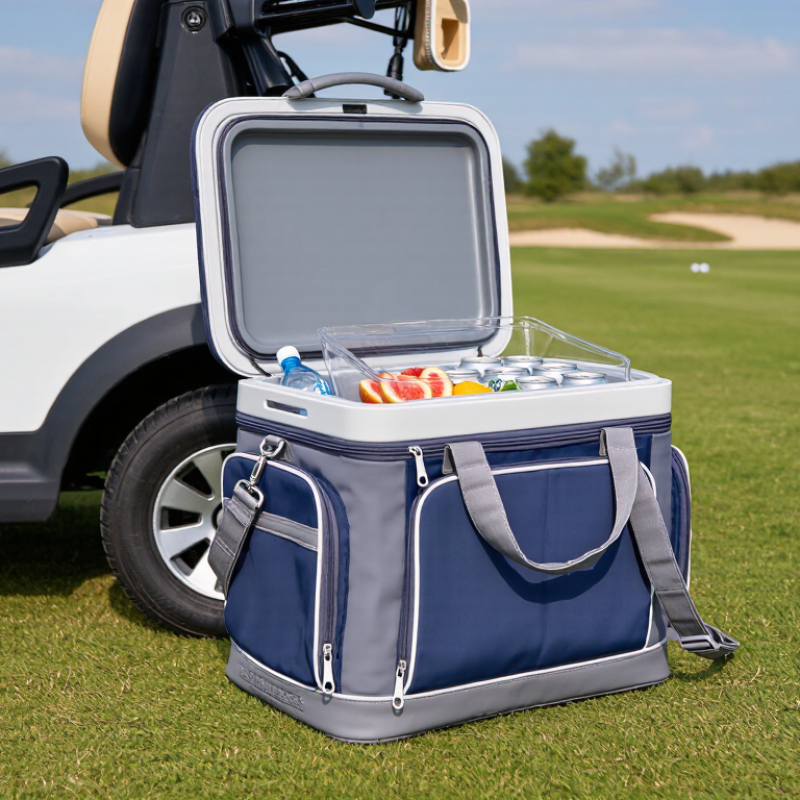
That limitation matters. A popular golf market does not guarantee fast-moving accessories. Joe Beditz, former president and CEO of the National Golf Foundation, has described golf as “a game for everyone.” For wholesalers, that idea points toward inclusive sizing, simple access, and practical carrying options. A Golf Cooler Bag should hold visible essentials, remain stable on a cart, and protect drinks through several holes. Insulation thickness, leak resistance, zipper quality, and easy-clean lining deserve close inspection. So do sample performance and factory consistency.
Wholesale decisions also require numbers. Compare usable capacity, minimum order quantity, customization fees, packaging, lead time, and landed cost. Ask whether the supplier can provide material specifications and test records. Grand View Research and other sporting-goods market analyses show continuing interest in functional, lifestyle-led products, yet they rarely isolate golf cooler bags. That gap should encourage caution, not inflated forecasts. A cheaper bag may create returns when seams fail beside a cart seat. A premium bag may move slowly if its colors feel too narrow. The best 2026 choice balances proof, practicality, and honest uncertainty. Forecasts can guide you. Samples decide.
A golf cooler bag is an insulated carry bag designed to keep drinks and snacks cold during a round. It usually includes thermal lining, leak-resistant compartments, durable handles, and space for personal equipment. For wholesale buyers, it is more than a beverage holder. It supports comfort, convenience, and visible course-side branding without naming a specific company.
The National Golf Foundation’s 2024 participation report recorded 47.2 million American golfers in 2023, including on-course and off-course participants. That broad audience creates steady demand for practical golf accessories.
A wholesale buyer should examine insulation time, zipper quality, drainage design, and carrying comfort. A bag that looks attractive but collapses under six cans may create returns. Small details matter.
Capacity must match the target customer. A compact model may suit walkers, while larger bags can serve groups or tournament gifting. The R&A’s Global Golf Participation Report shows golf activity spans many regions and playing formats. Therefore, climate, transport habits, and local purchasing power deserve attention.
Sample testing is essential. I once underestimated shoulder-strap comfort; the bag performed well, but felt awkward after several hours. That mistake remains useful.
Reliable sourcing also requires checking material specifications, food-contact claims, stitching strength, and packaging before placing a large order.
When choosing a golf cooler bag for wholesale, compare performance before appearance. Capacity should match common golf-day needs, such as six cans, two bottles, and ice packs. Ask suppliers for internal measurements, not only stated volume. Some bags look spacious but lose room through thick lining and pockets.
Insulation quality affects product reviews and repeat orders. Look for closed-cell foam, sealed seams, and a food-safe, water-resistant lining. A leak test matters. Request test photos or a sample filled with ice for several hours. Check zippers, stitching, shoulder straps, and base panels carefully. These parts often fail before the insulation. I have found that a comfortable handle can matter more than an attractive color. Wholesale buyers should also compare empty weight, folding ability, carton size, and shipping efficiency. A heavier bag may feel stronger, but it can increase freight costs.
Tips: Compare at least three samples under the same conditions. Measure cooling time, leakage, odor, and cleaning effort. Review minimum order quantities, color options, logo methods, and replacement policies. Ask whether materials remain stable after repeated use. Do not trust one perfect sample; production quality can vary. A small defect rate may still damage your margins. Also, buyers sometimes overvalue extra pockets. They can add bulk without improving daily use. Test the bag on a golf cart and beside a car seat. Practical details reveal more than a catalog image.
Matching cooler bag designs to golf customer groups is more effective than choosing one attractive style for every buyer. In wholesale projects, course conditions, playing habits, and spending levels usually shape customer expectations. A compact insulated sling suits casual players who carry only drinks and snacks. It should have a wide opening, a stable shoulder strap, and easy-clean lining. Keep it simple. For regular players, a structured 6–12 can cooler offers better organization. Add separated pockets for tees, gloves, scorecards, and personal items. Strong zippers and reinforced handles matter during repeated weekend use.
Premium golf customers often prefer quiet colors, precise stitching, and a firm silhouette that fits beside a cart seat. Water-resistant fabric adds practical value, but it should not be treated as waterproof without testing. Families and outdoor groups may need larger capacity, flexible compartments, and bright interior lining for quick visibility. Personalization can help wholesale buyers, yet oversized logos may reduce everyday appeal. Details matter.
From product sampling experience, many designs fail because they look impressive in photos but feel awkward when fully loaded. A cooler bag should be tested with ice packs, cans, towels, and golf accessories. Check balance, zipper movement, and shoulder comfort after several hours. One mistake is assuming every golfer wants maximum capacity. Some customers want less weight. Before scaling an order, compare two or three prototypes with real users. Their feedback may challenge the original design, which is useful. Final choices should balance appearance, durability, cleaning needs, and target price.
Material choice sets the bag’s lifespan. For wholesale orders, 600D polyester or recycled PET offers useful abrasion resistance. A laminated PEVA lining is easier to wipe than exposed fabric. However, recycled material can vary between suppliers. Request test samples before approving a large order.
Size should match real golf routines. The National Golf Foundation reported 28.1 million U.S. on-course golfers in 2024. Many players need space for two drinks, snacks, and ice packs.
A 6–10 liter bag fits a cart without becoming bulky. Larger 12–18 liter models suit shared use, but they increase freight volume and shoulder weight.
Foam thickness also matters. Closed-cell PE foam is usually lighter and more affordable than premium alternatives.
The USDA recommends keeping perishables below 40°F (4.4°C). Ask suppliers for measured retention results, not vague “all-day cold” claims. ASTM F2236 testing can make comparisons more credible, although field conditions remain inconsistent.
Tips:
Compare empty weight, zipper quality, seam sealing, and usable internal volume. Test one bag in a hot vehicle. Do not rely only on laboratory figures.
I have seen impressive insulation fail through a weak zipper. That detail is easy to miss. Wholesale value means dependable performance, not simply the lowest unit price.
In 2026, choosing a golf cooler bag for wholesale requires more than comparing catalog photos. Supplier reliability affects every later decision, from sample quality to delivery. Ask for material specifications, insulation thickness, zipper details, and stitching photographs. Request a physical sample before approving bulk production. Check whether the factory can repeat the same dimensions and cooling performance. A neat sample proves little. Review production records, quality checks, export experience, and responses to difficult questions. Clear answers usually reveal stronger process control.
Customization should begin with use, not decoration. Confirm logo size, printing method, color tolerance, lining, handles, pockets, and carton labeling. Ask for a digital proof and a pre-production sample with the final artwork. Small changes can alter sewing time and packaging volume. Compare unit pricing at several quantities, but calculate the landed cost. Include tooling, sampling, packaging, freight, inspection, taxes, and possible rework. A cheap quote may hide essential charges. I once underestimated packaging volume; the final freight estimate was higher than expected. That mistake was avoidable.
Order terms deserve the same attention as the product. Write the MOQ, lead time, payment schedule, inspection standard, defect remedy, and replacement procedure into the contract. Define approval points for materials, colors, artwork, and packing. Use a limited pilot order when the supplier is untested. Keep records of approvals and shipment photos. Do not rely on friendly promises. Some buyers focus too heavily on logo quality and overlook zipper failures after repeated opening. That is a useful gap to question before committing to a large order.
Wholesale evaluation matrix with indicative industry benchmarks for buyer comparison
| Evaluation Area | Key Metric | Practical Wholesale Benchmark | What to Verify with the Supplier | Buyer Decision Guidance |
|---|---|---|---|---|
| Supplier Capability | Relevant production experience | At least 3 years of experience producing soft coolers, insulated bags, or comparable sewn products | Factory profile, production photos, product range, export markets, and recent reference samples | Prioritize suppliers with direct experience in insulated construction and golf-accessory formats |
| Supplier Capability | Production capacity | Capacity should cover the planned order within the requested delivery window, with documented peak-season planning | Monthly capacity, current production load, equipment list, staffing, and backup production arrangements | Avoid relying on a supplier that cannot provide a written capacity commitment |
| Product Construction | Outer fabric | Common options include polyester or nylon fabrics in approximately 300D–600D weights; heavier fabric generally improves abrasion resistance | Fabric composition, denier, coating, colorfastness, abrasion resistance, and actual fabric swatch | Match fabric weight to the retail position, carrying conditions, and target selling price |
| Product Construction | Insulation and lining | Typical construction uses closed-cell foam insulation with a PEVA, EVA, or other wipe-clean lining | Insulation thickness, lining material, seam sealing, leakage resistance, and cold-retention test method | Request a physical sample and test it with the intended ice-pack configuration before approval |
| Product Capacity | Usable capacity | Approximately 6–12 cans is a practical range for a personal golf cooler; larger models may hold 12–18 cans | Internal dimensions, stated volume, can-count test, ice-pack space, and whether capacity includes accessories | Select capacity based on the expected use period, cart storage, and target customer profile |
| Golf-Specific Function | Carrying and attachment features | Useful features may include an adjustable shoulder strap, top handle, trolley attachment, exterior pockets, and drainage or leak-resistant construction | Load-bearing test, strap stitching, buckle strength, trolley compatibility, zipper operation, and pocket dimensions | Function should be tested while fully loaded, not only when the bag is empty |
| Customization | Logo application | Common methods include screen printing, heat transfer, embroidery, woven labels, rubber patches, and metal or silicone badges | Artwork requirements, printable area, color limits, sample approval process, decoration durability, and setup charges | Use decoration methods that remain legible on textured or curved surfaces |
| Customization | Custom color and materials | Stock colors usually require lower quantities; custom fabric colors may require a higher minimum order and longer development time | Color standard, fabric-dye minimum, lab-dip approval, color tolerance, and material substitution policy | Approve color by physical sample or lab dip rather than screen images alone |
| Customization | Packaging | Standard polybag and export carton packaging usually cost less than printed boxes, inserts, or retail-ready packaging | Packaging dimensions, carton quantity, gross weight, barcode placement, warning labels, and packaging test requirements | Confirm packaging before final quotation because it affects freight volume and landed cost |
| Pricing | Indicative unit price | Basic wholesale golf cooler bags commonly fall around USD 4–10 per unit; larger or more customized constructions may be higher | Price basis, quantity tier, material specification, decoration, packaging, tooling, inspection, and freight exclusions | Compare like-for-like specifications instead of choosing the lowest headline price |
| Pricing | Minimum order quantity | Stock designs may start at approximately 100–500 units; fully customized production often requires 500–1,000 units or more | MOQ by color, logo, size, material, packaging, and mixed-color policy | Calculate inventory risk using the MOQ for each individual color and specification |
| Pricing | Sample and tooling charges | Development samples, molds, plates, or embroidery files may be charged separately and may be refundable after a confirmed order | Charge list, revision policy, sample lead time, refund conditions, and ownership of custom tooling | Obtain written confirmation of all one-time charges before placing the purchase order |
| Order Terms | Production lead time | Stock or repeat orders may take about 20–35 days; new custom development and production commonly require about 35–60 days after approvals | Calendar or working days, approval starting point, material procurement time, holiday impact, and delay remedies | Build freight and inspection time into the launch schedule rather than using production time alone |
| Order Terms | Payment terms | A common arrangement is a deposit before production with the balance due before shipment or against agreed shipping documents | Deposit percentage, balance trigger, accepted payment methods, bank-charge responsibility, and refund terms | Tie the final payment to inspection results and documented order compliance where possible |
| Order Terms | Trade terms and shipping | Quotes may be offered on EXW, FOB, FCA, CIF, or DAP terms; the chosen Incoterm changes the buyer’s freight, insurance, customs, and delivery responsibilities | Named place, export clearance, freight inclusion, insurance, carton dimensions, gross weight, and estimated transit time | Compare total landed cost using the same Incoterm and destination assumptions |
| Quality Control | Inspection and defect standards | Use an approved sample, written specification, pre-shipment inspection, and an agreed defect classification system | Inspection method, sampling plan, acceptable quality limits, repair policy, replacement policy, and inspection cost | Do not rely on visual approval of one sample without defining production tolerances |
| Compliance | Material and market requirements | Requirements vary by destination and may include chemical, labeling, packaging, social-compliance, or product-safety documentation | Applicable destination-country regulations, material declarations, test reports, restricted-substance documentation, and labeling files | Confirm compliance requirements before production, especially for products intended for children or food-contact use |
| Commercial Risk | Quotation transparency | A reliable quotation should separate product cost, customization, packaging, tooling, inspection, freight, taxes, and other charges | Validity period, currency, price-adjustment conditions, excluded costs, and revision history | Score suppliers higher when quotations are detailed, comparable, and contract-ready |
| Final Selection | Weighted supplier score | Suggested weighting: product quality 30%, total landed cost 20%, delivery 15%, customization 15%, compliance 10%, communication and risk 10% | Score each supplier using the same evidence, samples, specifications, and commercial assumptions | Choose the supplier with the strongest overall value and lowest controllable risk, not necessarily the lowest unit price |